
Tampa Bay Metro
Small Bay Industrial Warehouse
Treme-Parker is pleased to present a $5.2M JV equity opportunity for the construction of a 67,502 square foot, fourteen unit small-bay industrial development on 4.85 net buildable acres within an institutionally owned and tenanted industrial park at the geographic center of Pinellas County, Florida. The encompassing institutional-quality industrial tenant and ownership roster reflects the strength of the submarket. Notable occupants include Amazon, FedEx, Lockheed Martin, and Cintas; ownership groups include EQT Exeter, One Liberty REIT, Stonemont, Ivanhoe Cambridge, and Greystar. The site offers direct access to I-275, Highway 694, and U.S. Route 19, enabling efficient distribution throughout the Tampa Bay region. The $5,802,514 total equity position against a $16,566,673 total capitalization, will stand alongside a construction facility sized at sixty-five percent of cost. The land is under contract on an off-market basis, entitlements are substantially complete, and the project is positioned to break ground in the first quarter of 2027 with a targeted disposition thirty-four months from the land closing.
The thesis is arithmetic before it is narrative. The project converts land acquired at $597,938 per acre into stabilized industrial cash flow at a 7.41 percent untrended yield on cost, in a submarket where comparable product clears at a six percent capitalization rate and where the most recent trade of newly constructed small-bay product cleared at four percent. That 141 basis point development spread, widening to 178 basis points on the trended sale year, is the entire engine of the return. It requires no capitalization rate compression; the exit is held flat at six percent from execution through disposition. It requires no heroic rent growth; the underwritten rent sits within the observed comparable band. Held constant, the spread produces $3,904,917 of value creation over basis, a twenty-four percent premium of stabilized value to cost, and it is created at acquisition rather than assumed at exit.
The supply argument is unusually clean. Pinellas County is the most densely populated county in Florida, its industrial land is effectively built out, and every new square foot of inventory must displace an existing use rather than rise from a greenfield site. Submarket vacancy runs between four and five percent. No small-bay industrial delivered in the most recent quarter, and no small-bay deliveries stand in the construction pipeline. Scarcity here is structural rather than cyclical: the constraint is dirt, and dirt in Pinellas is not being manufactured. A developer holding permitted, fully improved land in this market does not compete on price; he competes against the absence of alternatives.

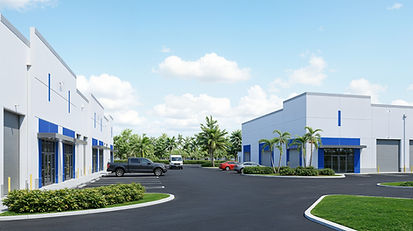

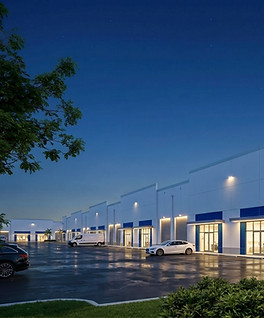
Commerce Centre Summary
-
67.5k Square Feet
-
14 Units
-
2 Buildings
-
20' Clear Height
-
4,800 s/f Units
-
One 12' x 14' OH Door per unit
-
800 s/f Office per unit
-
Air Conditioned Office Spaces
-
3 Phase Power: 2k Amps
-
Concrete Tilt-Wall Construction
Execution is equally direct. Each of the fourteen suites is delivered with a finished 800 square foot air-conditioned office, a dedicated overhead door, twenty foot clear height, and complete tenant improvements at construction completion. The small-bay tenant is a contractor, distributor, service firm, or light manufacturer running a payroll that cannot absorb a ninety day buildout, and turnkey delivery on day one removes the single most common reason such a tenant walks away. The underwriting assumes no preleasing whatsoever and still reaches stabilization fifteen months after delivery. Fourteen units also mean that no single tenant occupies more than 8.1 percent of net rentable area, trading a modest increase in management intensity for a genuinely diversified rent roll in which the loss of any one tenant is an inconvenience rather than an event. The development partner is a family-held Florida builder operating continuously since 1979, with tens of millions of square feet delivered statewide, and constructs its own work rather than subcontracting the largest line item in the budget to a party whose incentives diverge from the owner's.
Structurally, Limited Partner capital funds first in the stack and is first in, last out, with no back-ended equity tranche standing ahead of it. Capital is fully deployed within four months of the land closing and returns begin well before disposition: a permanent financing at stabilization is projected to return approximately forty-five percent of contributed capital in the twenty-fifth month, nine months ahead of the sale, materially shortening the effective duration of the commitment. The base case targets a 21.0 percent internal rate of return and a 1.61 times equity multiple to Limited Partners over a thirty-four month hold, behind a ten percent preferred return with full catch-up and a tiered promote that pays the sponsor only after investors are made whole. Discipline defines the downside as clearly as the upside. Investor capital is preserved through 169 basis points of exit capitalization rate expansion or a 21.9 percent erosion of net operating income, and the construction budget carries a seven percent contingency in two layers.
Investment Summary
-
Total Project Cost: $16.6M
-
LP Equity: $5.2M
-
GP+Land Value: $3.5M
-
LTC: 65%
-
Construction Debt: $10.8M
-
Construction Period: 11 mos
-
Stabilization: 25 mos
-
Stab. NOI: $1.2M
-
Stab. Debt Yield: 11.41%
-
Stab. Yield on Cost: 7.41%
-
Exit Value: $21.5M (6% CAP)
-
Min Hold: 34 mos
-
LP IRR: 21%
-
LP Equity Multiple: 1.61x
178bps
Developement Spread
26%
Project IRR
7.78%
Yield On Cost